
Utilities And Infrastructure Projects Using Precast Kentledge Concrete Blocks
Robust, Flexible Solutions for Critical Utilities and Infrastructure Assets
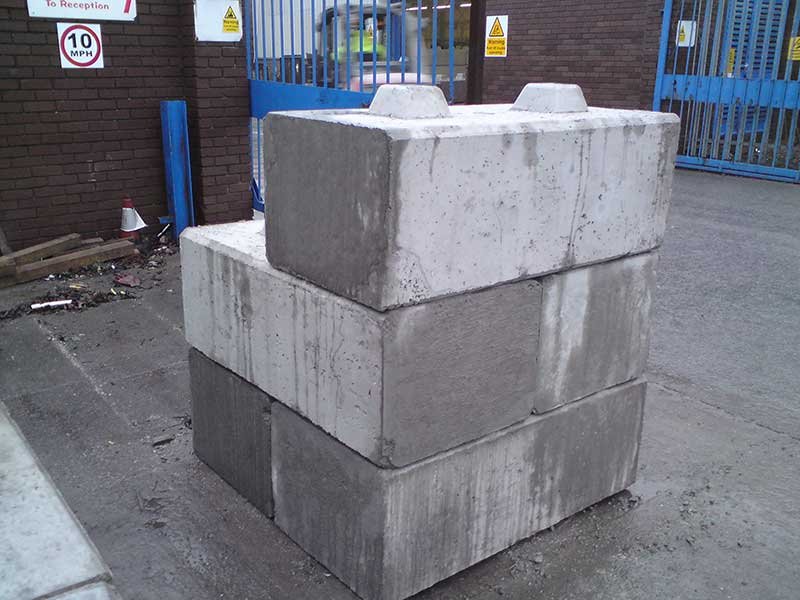
Utilities and infrastructure projects demand construction solutions that deliver long-term stability, safety, and programme certainty. Precast concrete blocks, including ballast blocks, kentledge blocks, and specialist load-bearing units, are widely used across utility and infrastructure schemes to provide reliable mass, stability, and load control with minimal ground disruption. From power and water infrastructure to highways, rail, and telecommunications, precast concrete blocks support both permanent and temporary works where resilience and compliance are essential.
What Are Kentledge Blocks?
What Role Do Precast Concrete Blocks Play in Utilities and Infrastructure?
In utilities and infrastructure environments, precast concrete blocks are used to provide deadweight, restraint, and structural support without the need for extensive excavation or permanent anchoring.
Manufactured to known specifications, these blocks offer predictable performance across a wide range of civil engineering applications. Their modular, reusable nature makes them particularly valuable on complex, phased, or access-restricted sites.
Why Choose Elite Precast
With decades of precast expertise, in-house engineering support and a proven delivery record on projects of every scale, Elite Precast is the partner specifiers trust. We pair robust, repeatable manufacturing with the flexibility to engineer bespoke solutions when a standard product will not do.
Key Applications
Key Applications of Kentledge Blocks in Utilities and Infrastructure Projects
Substations and Energy Infrastructure — Precast blocks are commonly used to provide stability and support for:
Electrical substations and switchgear
Transformers and battery storage units
Temporary and permanent power installations
They help control settlement, resist uplift, and protect critical assets throughout their operational life.
Water, Wastewater, and Flood Defence Schemes — In water sector projects, blocks are used for:
Temporary works restraint
Pipework and manifold stabilisation
Pumping stations and treatment plant infrastructure
Flood defence and scour protection systems
Their durability and mass make them well suited to wet and aggressive environments.
Highways, Rail, and Transport Infrastructure — Precast concrete blocks support transport projects by providing:
Temporary foundations for gantries and signage
Ballast for bridge works and temporary supports
Stabilisation for roadside and rail-adjacent infrastructure
Rapid installation reduces possession times and traffic disruption.
Telecommunications and Data Infrastructure — Blocks are used to support:
Temporary and permanent telecoms equipment
Data centres and modular plant
Antenna bases and ancillary infrastructure
Their use avoids deep excavations in congested or sensitive urban locations.
Temporary Works and Construction Phases — Across all infrastructure sectors, precast blocks are widely used for:
Temporary foundations
Restraining loads
Load testing and commissioning
Phased construction support
Blocks can be removed, reused, or reconfigured as projects evolve.
Benefits
Minimal Ground Disturbance — Ideal for brownfield and live environments.
Fast Installation — Precast solutions reduce programme risk.
Reusable and Sustainable — Supports circular construction principles.
Predictable Load Performance — Manufactured to known specifications.
Reduced Site Risk — Less excavation and in-situ concrete work.
Adaptable Across Project Phases — Suitable for temporary and permanent use.
Engineered for Your Environment
Engineered for Critical Infrastructure Environments
Our precast concrete blocks are designed to meet the demanding requirements of utilities and infrastructure projects. Each unit is produced under factory-controlled conditions to ensure consistent quality, durability, and performance. Options include:
Integrated lifting points for safe handling
Clear weight identification
Bespoke geometries for confined or constrained sites
Compatibility with standard civil engineering practices
We collaborate closely with asset owners, contractors, and designers to ensure solutions align with operational, safety, and maintenance requirements.
Compliance, Safety, and Assurance
Precast concrete blocks are widely accepted across the utilities and infrastructure sectors and support compliance with:
Temporary works and structural design guidance
Health and safety regulations
Sector-specific standards for energy, water, and transport
Full technical documentation, including weight certification and manufacturing records, is available to support approvals, audits, and asset handover.
Why Choose Kentledge Blocks for This Application?
As utilities and infrastructure networks expand and modernise, project teams require solutions that balance speed, safety, and long-term resilience. Precast concrete blocks offer a flexible, low-risk approach to stability, load control, and temporary works across a wide range of applications.
Whether supporting critical energy assets, transport infrastructure, or water systems, precast blocks deliver dependable performance where it matters most.
Featured products

Frequently Asked Questions
Are precast concrete blocks suitable for live utility environments?
Yes. Their rapid installation and minimal excavation make them well suited to live sites where downtime and disruption must be minimised.
Can blocks be used as permanent infrastructure solutions?
Yes. When correctly specified and installed, precast blocks can form part of permanent support and stability systems.
Are blocks reusable between infrastructure projects?
Absolutely. Reusability is a major advantage, particularly for framework and term-contract work across multiple sites.
How are loads calculated and verified?
Each block is manufactured to a known weight, allowing engineers to accurately calculate applied loads and safety factors.
Can blocks be customised for restricted or urban sites?
Yes. Bespoke sizes, shapes, and weights can be produced to suit access-limited or congested environments.
Do precast blocks meet sustainability objectives?
Yes. Reduced excavation, reuse, and controlled manufacturing all contribute to lower environmental impact compared to traditional solutions.